 Gift
Gift Tickets
 Membership
 Contact
 Donate
 Shop
ShopHell-bent on Studying Eastern Hellbenders: Virginia Zoo Keeper Volunteers with the North Carolina Wildlife Resources Commission
The Virginia Zoo’s Conservation Committee designates part of the Zoo’s Conservation Fund to grant opportunities for staff to engage in on-site conservation projects and community science initiatives, furthering their personal and professional development. Keegan Gindling, Herpetology Keeper, received a Conservation and Research Grant to take part in hellbender surveys with the North Carolina Wildlife Resources Commission (NCWRC) this past July. Read on to learn more about Keegan’s work surveying hellbenders!
Eastern hellbenders are the largest species of salamander in the Americas, reaching up to 29 inches in length. They are native to cool, clean rivers and streams across 15 states, primarily around the Appalachian Mountains. A clean habitat is especially important to eastern hellbenders because they are amphibians, absorbing oxygen and environmental pollutants through their skin. In 2024, the United States Fish and Wildlife Service proposed to list eastern hellbenders as endangered throughout their range due to threats from water quality degradation, sedimentation, habitat destruction, and disease. Historically, there were 626 known populations of eastern hellbenders, but 41% of these are thought to be locally extinct with an additional 36% declining.
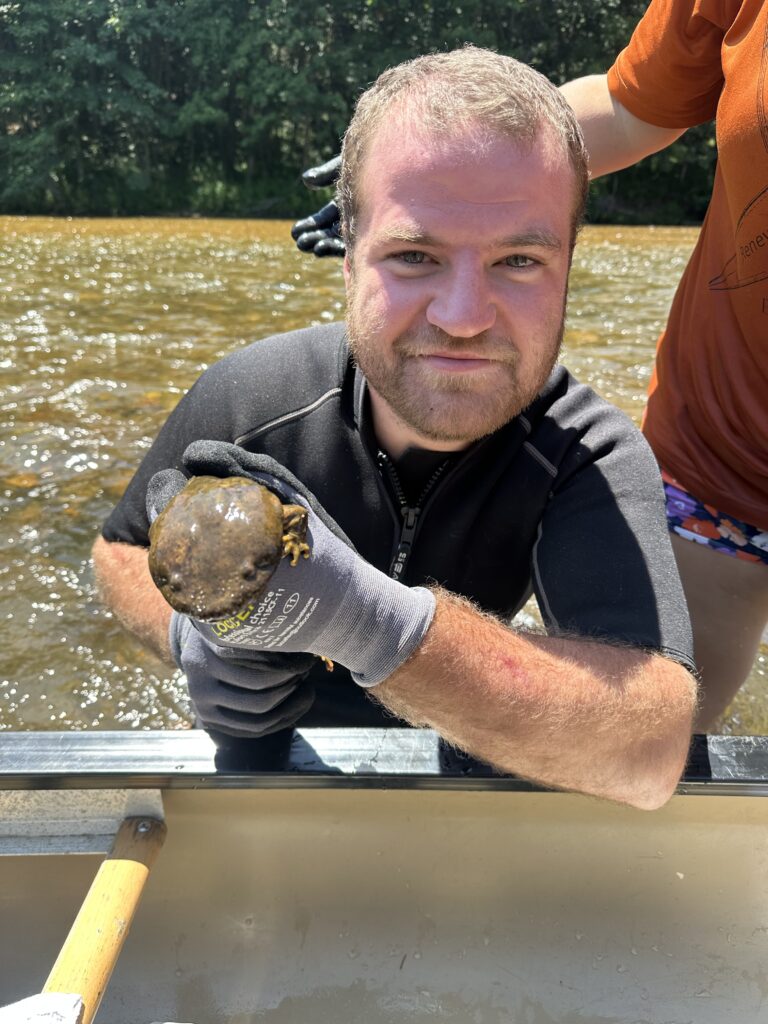
One population of eastern hellbenders in North Carolina is found in the New River. This population is surveyed annually by the North Carolina Wildlife Resources Commission (NCWRC) with the help of volunteers like Keegan. Typically, a week-long survey is conducted each year to monitor changes in the population. However, since Hurricane Helene devastated North Carolina’s landscape last year, the NCWRC decided to extend their survey across four weeks to establish a new baseline following the storm.
Surveying eastern hellbenders is no easy feat. Every day, there were 15-30 volunteers working together on this project across several different roles. Keegan was able to take part in each one, gaining a more thorough understanding of the research process. One role was to be a diver, snorkeling through the river and turning over small rocks in the muddy riverbed in search of hellbenders. The divers also looked for large, flat rocks with a small gap underneath them, big enough to fit your hand but not your whole arm. These are the perfect nursery rocks for females to lay their eggs under and for males to use to guard the nests.
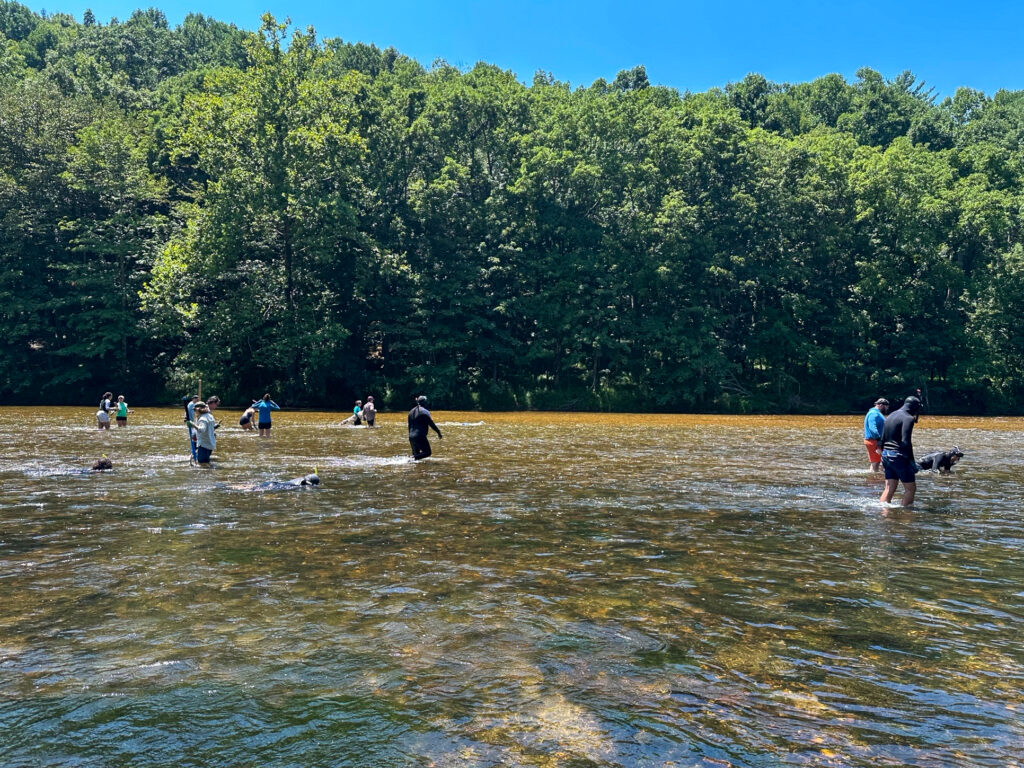
Lifters walked through the river closely behind the divers, carrying cant hooks to pry the rocks from the riverbed. Moving the rocks could startle the animals underneath, so there was a third team of volunteers holding a sieve net open downstream to catch any hellbenders as they left their hiding spot.
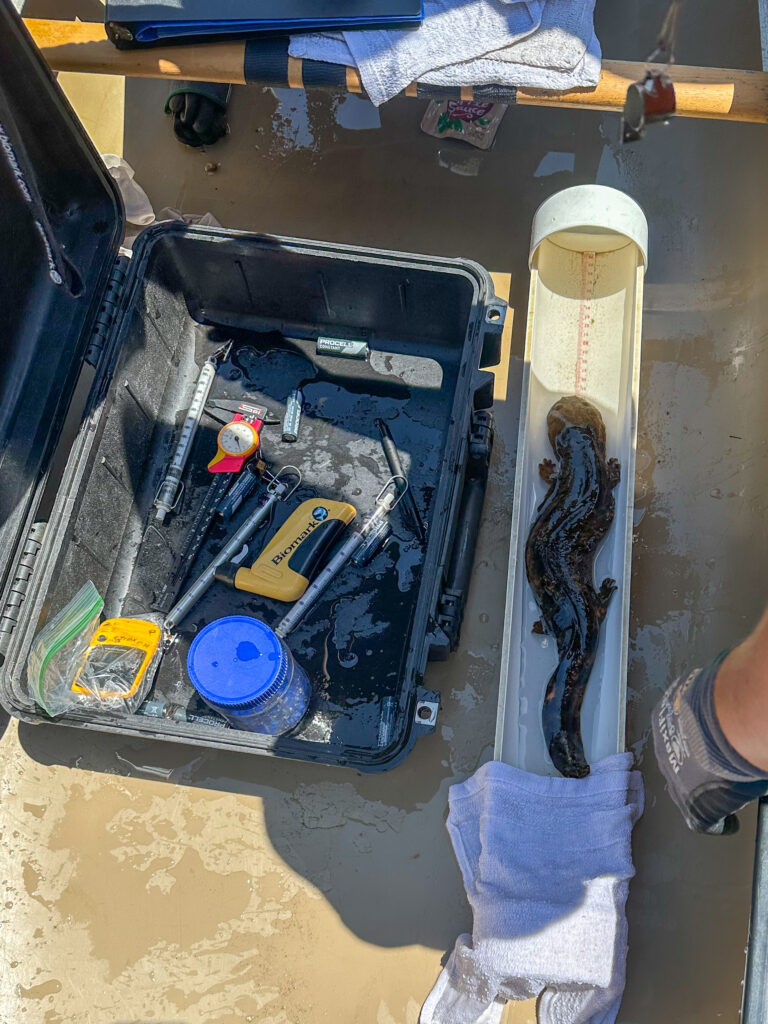
When the volunteers found a hellbender, they carried them over to a canoe with data collection tools. The team recorded the GPS location of where the hellbender was found, the individual’s length from tip to tail and from snout (nose) to cloaca (waste and reproductive opening), and their sex. Males are easily identifiable during the breeding season due to swelling around their cloaca. They also recorded the presence of external parasites, like leeches, on the hellbenders. External parasite load can indicate these animals’ overall health, as their species is negatively affected by leeches that transmit dangerous parasites directly into the hellbender’s blood. Amphibians worldwide have declined rapidly, in part, due to the prevalence of diseases. Most importantly, researchers scanned the hellbender to look for a PIT tag, which is essentially like a microchip that your vet would give your dog or cat, to identify if this individual had been found in previous years’ surveys. If the individual did not have a PIT tag, then they would be given one to ensure they can be identified again next year. Keegan noted that many of the hellbenders found during the survey were new individuals without a PIT tag, indicating that while hellbenders may have been lost in the storms, the population is still successfully recruiting new individuals that have not been surveyed before.
Keegan hopes to return to North Carolina next year to see how the hellbender population has changed. He is also interested in assisting with similar research in Virginia, since the New River actually flows north into our state, and methods for studying hellbenders are highly variable from state to state or even researcher to researcher. For example, some scientists have created concrete nest boxes to encourage hellbender nesting behavior. These nest boxes allow scientists to monitor hellbender populations in a less invasive way, without disturbing the natural microhabitats underneath rocks. The Virginia Zoo can’t wait to see what important conservation work Keegan does next!