 Gift
Gift Tickets
 Membership
 Contact
 Donate
 Shop
ShopA Week in the Life of a Global Protagonist
The Virginia Zoo Conservation and Research Grant offers staff the opportunity to engage in on-site conservation projects and community science initiatives to further their personal and professional development. Emily Spence, Curator of Africa, received this funding to take part in South African wildlife conservation projects this past August. Read on to learn more about Emily’s exciting fieldwork opportunity.
Emily was able to participate in a rhino dehorning process through an organization called Global Protagonists. Their mission is to connect people who are looking to “travel with purpose” to frontline conservation projects worldwide. Emily’s trip was led by Stephanie Arne, an international wildlife conservation expedition guide, and partnered with a local company called Wildscapes Veterinary and Conservation Services. Wildscape’s mission is to deliver exceptional veterinary care and provide innovative management solutions to protect wildlife worldwide. Emily spent six days in Hoedspruit, South Africa working with Wildscapes. Below is a breakdown of how she spent each day!
Monday
Emily spent the first morning of her trip at Madrid Game Reserve working with Dr. Bart Gazendam, a veterinarian with Wildscapes. Dr. Gazendam was brought to Madrid Game Reserve to anesthetize and move male antelope throughout the preserve for breeding purposes.

This preserve had an extremely large tick population, but some antelope appeared to be immune to the ticks. Dr. Gazendam hoped that tick immunity was an inherited trait, so by moving males with this trait to another part of the preserve, they could increase the portion of the reserve’s antelope population with resistance to ticks. The team drew blood samples from each animal, vaccinated them, and treated them for ticks. Treating an antelope for ticks is surprisingly similar to what you would do for your own pets! The team applied a thick, medicated liquid along each antelope’s back. After receiving veterinary care, the antelopes were moved across the preserve to different fenced-in areas of the property. The team moved seven male antelopes total that day. Emily also had the chance to see impalas, blue duikers, giraffes, and nyala while visiting the preserve.
Emily spent the afternoon touring the Moholoholo Wildlife Rehabilitation Centre. This rehabilitation center provides medical care for animals that had been snared, saved from canned hunting facilities, and more. She even had the chance to see Stoffel, the honey badger who went viral online for escaping the rehabilitation center repeatedly!
Tuesday
On the second day of the trip, Emily’s tour group traveled up into the mountains out of Hoedspruit to a private reserve. Here, the group assisted Wildscapes owner Dr. Ben Muller with anesthetizing and moving cape buffalo around the reserve. Emily’s volunteer group was joined by state veterinarians who also worked to test the cape buffalo for tuberculosis.
Since the cape buffalo were in such a large herd, the team anesthetized three individuals at a time and separated them for medical treatments. When the cape buffalo were separated from the herd, Emily’s team did blood draws and applied tick preventatives, while the state vets worked on testing the cape buffalo for tuberculosis. Emily’s tour group helped move a total of 11 cape buffalo around the preserve!
Wednesday and Thursday
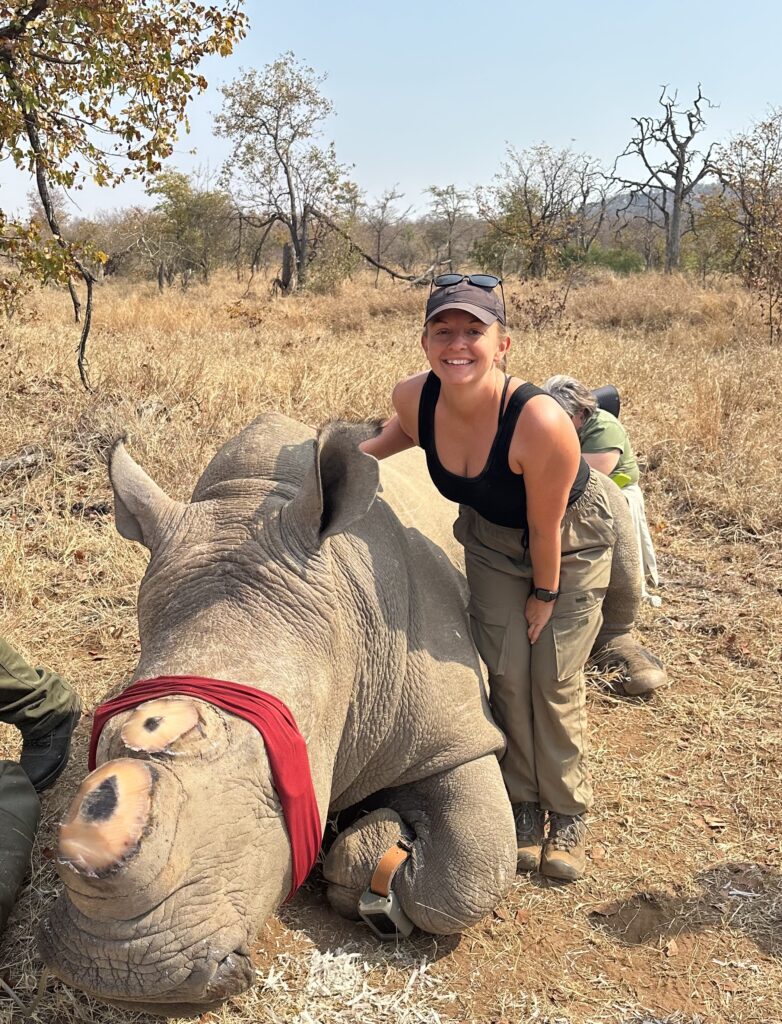
Emily spent the third and fourth days of her trip at Selati Game Reserve working alongside Dr. Joel Alves, Dr. Ben Muller, veterinary nurse Leah Brown, the Selati team, and a group of researchers, to dehorn rhinos. The team dehorned 10 rhinos the first day and six on the second day, due to the high temperatures. Five of the rhinos were critically endangered black rhinos, and 11 were near threatened southern white rhinos. Adults, subadults and several mom-calf pairs were dehorned.
Dehorning rhinos is one of the best ways to conserve their species, because it does not harm the rhinos to live without horns, but it does reduce their value to poachers. There are only five species of rhinoceros in the world – three are critically endangered, one is vulnerable, and one is near threatened with extinction. The single greatest threat to the survival of these magnificent mammals is poaching for their horns. Some cultures believe that rhino horns have medicinal properties while in others, possessing a rhino horn is a status symbol. Consequently, rhino populations have drastically declined from approximately 500,000 individuals in the early 20th century to 70,000 in the 1970s to now only around 27,000 remaining in the wild today.
The dehorning process began with the Selati Game Reserve team using thermal detecting drones and planes/helicopters to locate and track the rhinos. The rhinos were then darted by the vets from a helicopter while three teams on the ground stood by until the rhinos were anesthetized. Both horns were removed from each rhino. Rhino horns are made from keratin, the same protein found in human hair and fingernails, so they do grow back. Ideally, a rhino should be dehorned every two to three years to stay safe from poachers.
Emily spent Thursday afternoon at one of the Black Mambas’ home bases. Here, she had the opportunity to meet Collette Ngobeni, a supervisor of the Black Mambas, to learn about how their group patrols Greater Kruger National Park, works within local communities to inspire young people to protect wildlife, and changes the minds of community members who are already involved in poaching or snare hunting. This experience was especially memorable for Emily, since our Southern white rhino calf, Letti, is named after Black Mamba Sergeant Nkateko Letti Mzimba!
Friday
Emily spent day five of the trip at Leopard Park Nature Reserve working with a large sable antelope herd. In this preserve, Emily’s group assisted Dr. Ben Muller with anesthetizing female sable antelopes and transporting them to a separate pasture. These antelopes were scheduled to undergo embryo transplants to increase genetic diversity amongst populations in other game reserves. In the afternoon, Emily’s group was even allowed to ride in a helicopter and practice darting a moving target under the direction of Dr. Muller!
Saturday
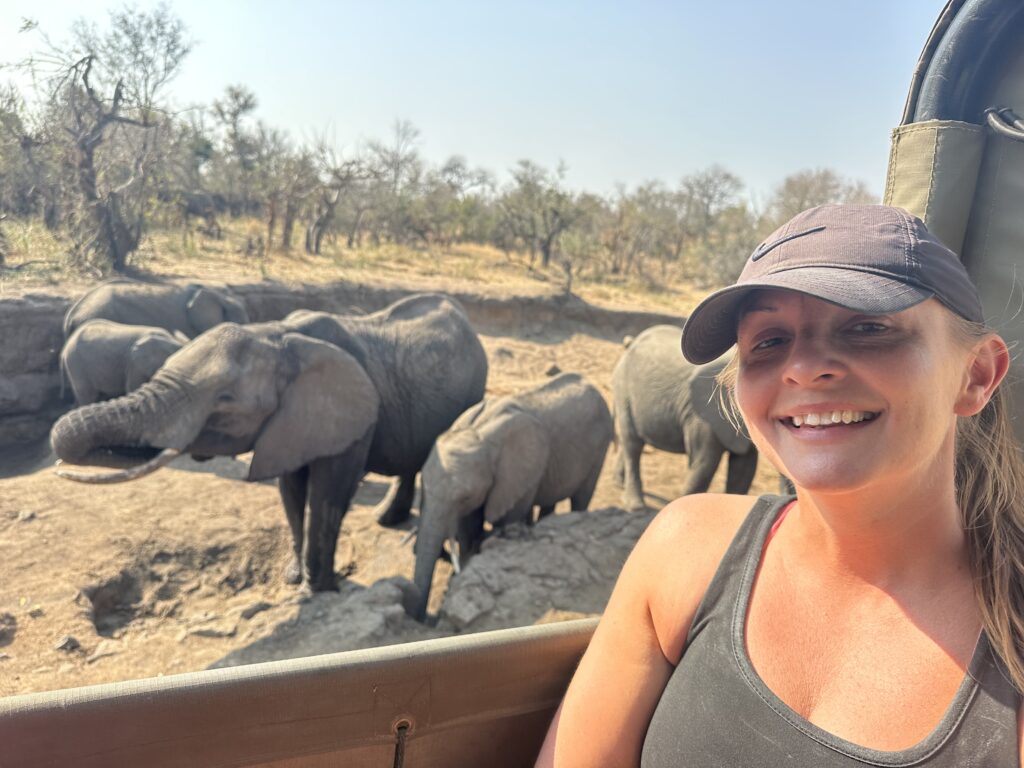
On the last day of Emily’s conservation trip, her tour group split into two and went on a guided safari in Kruger National Park. She saw several elephants, a herd of about 30 Southern Giraffe, a pack of wild dogs, a large cape buffalo herd, and three male lions tracking the cape buffalo herd. It was a very hot day at the end of the dry season, so the group even saw elephants playing in the water and mud to cool down!
Emily’s final day showed her the harsh realities of the dry season in South Africa. Every part of the National Park had sparse foliage left for herbivores to eat and very little water. The remaining watering holes were hotspots of activity, like an oasis in the desert. She says this experience served as an impactful reminder of how African animals have adapted to surviving in such a harsh environment.
For Emily, traveling to Africa was unlike any other experience and truly transformative. Seeing the species that she works with every day in their wild habitat and the harsh realities that they have to face was an amazing opportunity. She also found it interesting to learn how the people of South Africa, live alongside these amazing animals, and the work that they are doing to protect these species firsthand. Emily is incredibly grateful that the Virginia Zoo has the ability to send keepers on these conservation missions to work directly with conservation programs across the globe. She is excited to share her knowledge of conservation medicine with our Africa Keepers and guests on behind-the-scenes tours.