 Gift
Gift Tickets
 Membership
 Contact
 Donate
 Shop
ShopRhinoceros Hornbill
Description
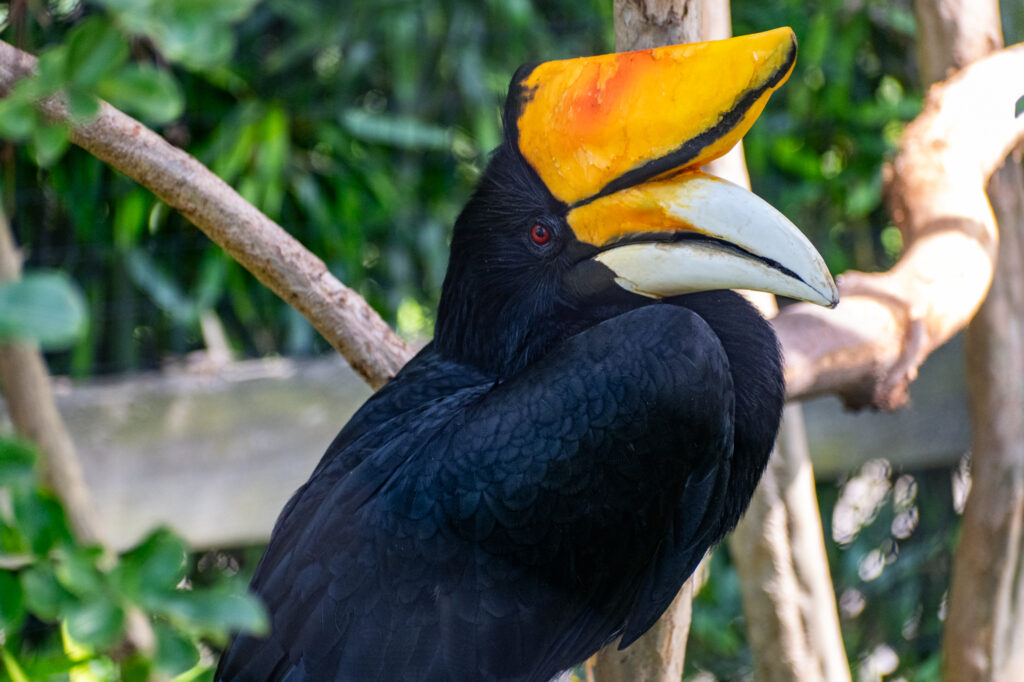
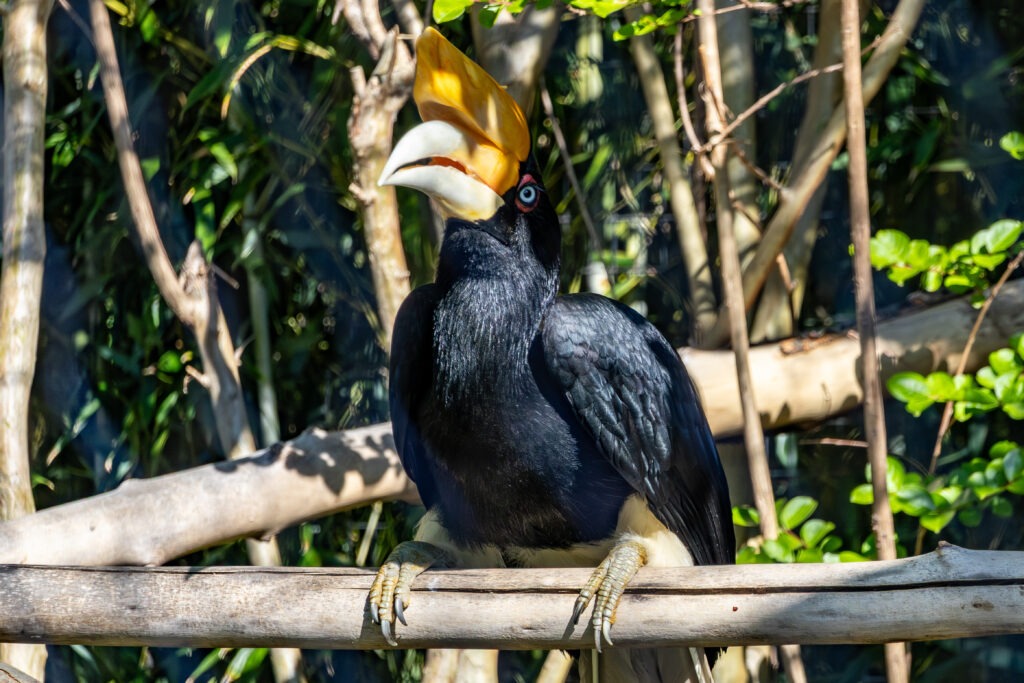
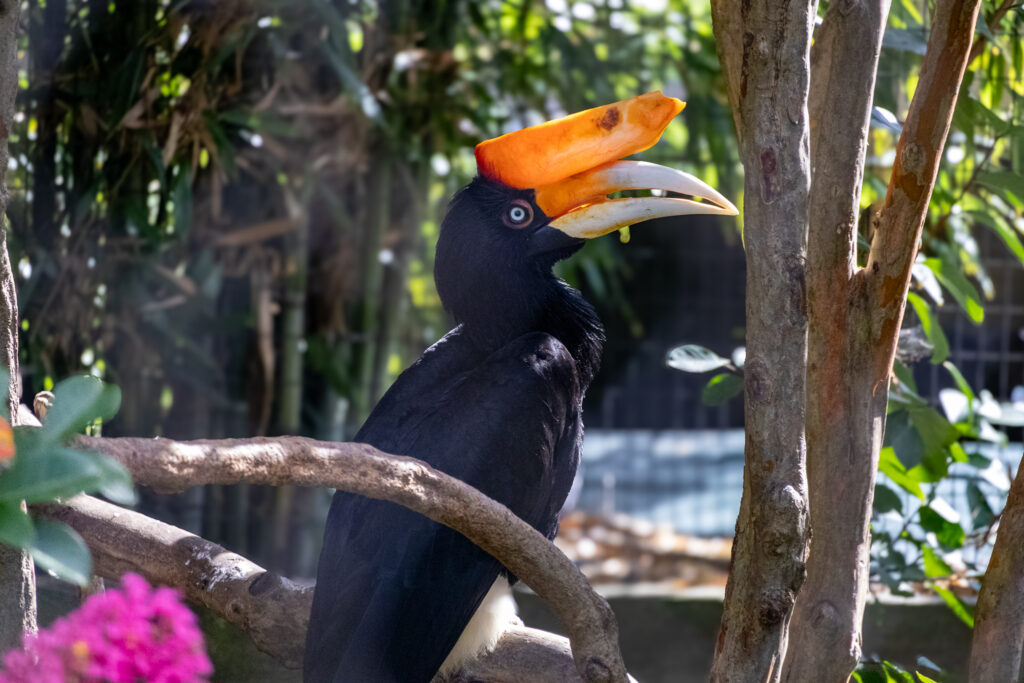
Rhinoceros hornbills have black feathers with white legs, a white tail with a black band, and a unique bill. Their bright yellow-orange casque, the hollow “horn” on top of their bill, is made of keratin and is thought to help amplify their loud calls. The Javan subspecies of rhinoceros hornbill, Buceros rhinoceros silvestrisus, differs from related subspecies in that they have a broader black tail band and a forward-pointing, straight casque.
Rhinoceros hornbills are sexually dimorphic, meaning that males and females of the same species differ in appearance. Males have red eyes with a black rim around them, while females have red-rimmed white or light blue eyes.
Range & Habitat
There are three subspecies of rhinoceros hornbill which are located in distinct regions of southeast Asia. Buceros rhinoceros rhinoceros can be found in south Thailand, the Malaysian Peninsula, and Sumatra. Buceros rhinoceros borneoensis can be found in Borneo, Indonesia. Buceros rhinoceros silvestris can be found in Java, Indonesia.
All rhinoceros hornbill subspecies are found in primary tropical evergreen forests and mature secondary forests. Occasionally, rhinoceros hornbills fly over disturbed agricultural areas to travel to different feeding grounds.
Behavior
Rhinoceros hornbills exhibit unique nesting behavior which requires significant trust between partners. After mating, the female finds a cavity in a hollowed out tree to nest in. She uses mud and feces to seal most of the cavity, leaving a small hole for the male to pass her food. She stays in the cavity nest to incubate the egg for 80-90 days and later cares for the young chick for an additional 45 days after hatching. When the female leaves the nest, both parents reseal the chick inside and continue to feed the chick until it is about 80 days old.
Diet
These birds are omnivorous, but the majority of their diet consists of fruit. Rhinoceros hornbills show a strong preference for figs, but they also eat other fruits in the drupe family. During the breeding season, rhinoceros hornbills may eat other animals opportunistically to feed their young protein. Prey includes invertebrates (e.g. insects), lizards, rodents, tree frogs, and bird eggs.
Conservation
Rhinoceros hornbills are threatened by habitat destruction for agriculture, especially palm oil plantations, and logging.
This species is also poached for their feathers, beaks, and casques which are often used in ceremonial dress by local people. Rhinoceros hornbills are also occasionally caught as bycatch by people targeting the helmeted hornbill for its ivory-like casque.
Fun Facts
- The rhinoceros hornbill is the national bird of Malaysia and the state bird of Sarawak, Malaysia.
Virginia Zoo Animals
Male: Riobi (hatched: March 8, 2008)
Female: Phoenix (hatched: May 20, 2012)
Scientific Name
Buceros rhinoceros silvestrisus
IUCN Conservation Status
Vulnerable
Size
Length: 31-36 inches
Weight: 4-7 pounds
Life Expectancy
35 years in human care
Phoenix
Riobi
Phoenix