 Gift
Gift Tickets
 Membership
 Contact
 Donate
 Shop
ShopDig in to armadill-ightful facts for International Armadillo Day
Happy International Armadillo Day! Celebrated each year on August 13, this day raises awareness for the 25 species of armadillos found across North, Central, and South America. The Virginia Zoo is home to three species of armadillos: the screaming hairy, Southern three-banded, and six-banded armadillo. Read on to learn more about this unique family of animals, the distinct species we have here at the Zoo, and the individuals that call the Zoo home.
All species of armadillo belong to the taxonomic superorder Xenarthra alongside their unique relatives, sloths and anteaters. However, unlike sloths or anteaters, armadillos are known for their hard shells, also called carapaces, that cover their backs. In fact, their name, “armadillo”, even translates to “little armored one” in Spanish! An armadillo’s carapace is made of strong keratin plates called scutes. Their tails, the tops of their heads, and the outer portions of their limbs are also typically covered in scutes for protection.
Screaming Hairy Armadillo
The screaming hairy armadillo, Chaetophractus vellerosus, is aptly named for their defining characteristics. When threatened, armadillos of this species make a loud squealing sound, and they have long, white or light brown hairs sticking out from between their scutes. Of all the armadillos at the Virginia Zoo, screaming hairy armadillos have the most bands in their carapace; in total, they have 18 bands, but only about six to eight are movable.
Screaming hairy armadillos are native to Bolivia, northeastern Chile, Paraguay and south to southwestern Argentina. Their preferred habitat has dry, sandy soil, which allows them to burrow easily. Like other species in their family, screaming hairy armadillos are omnivores, but they exhibit some unique feeding behaviors. For example, screaming hairy armadillos are known to burrow under and into carrion in search of insects to consume. Additionally, while other armadillos use their legs and claws to forage for invertebrates, screaming hairy armadillos have been observed sticking their head in the ground and turning in a circle to create a cone-shaped hole in soil.
The Virginia Zoo is home to three screaming hairy armadillos, Dora, Squeaker, and Olivia. Dora and Squeaker live behind the scenes, as they are specially trained Animal Ambassadors. They are also a recommended breeding pair according to the Screaming Hairy Armadillo Species Survival Plan (SSP). Dora is known for seeking out dark napping spots and can often be seen turning over dig boxes to sleep comfortably under them. Squeaker, on the other hand, can be found stretching out and basking under his heat lamp.

Olivia resides in the Yellow Barn at the ZooFarm, neighboring our northern tree shrews and Prevost’s squirrel. Though Olivia may be difficult to spot in her habitat because she spends most of her day hiding, she is not shy – she just saves her energy for when her keepers have the tastiest parts of her diet in hand!
Southern Three-Banded Armadillo
The Southern three-banded armadillo, also known as the La Plata three-banded armadillo or by the scientific name Tolypeutes matacus, is unique in that it is the only armadillo species that can completely curl up into a ball to protect itself. Other armadillos will typically run and press their underside into the dirt to prevent themselves from getting flipped over. Unfortunately, this defense mechanism in three-banded armadillos has made them vulnerable to poachers who collect this species for the pet trade, their shells, or meat.
This species is native to eastern Bolivia, southwestern Brazil, the Gran Chaco region of Paraguay, and northern and central Argentina in open grasslands, forests, and marshes. For many years, scientists believed that three-banded armadillos did not dig burrows, as they are often found resting in shallow depressions covered in leaf litter or straw nests; however, it turns out they are capable of digging small burrows!
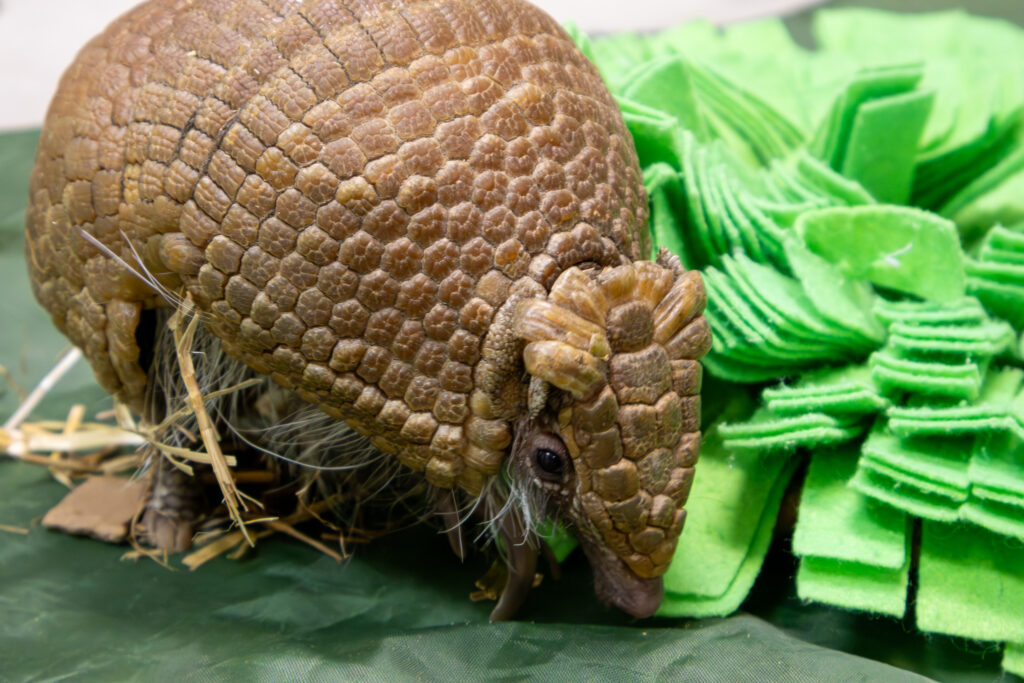
The Virginia Zoo is home to two three-banded armadillos named Vigo and Izel. Both Vigo and Izel are Animal Ambassadors and can often be seen in their playpens during special events or education programs. Like Dora and Squeaker, our Southern three-banded armadillos are a recommended breeding pair according to their Species Survival Plan (SSP). In fact, Vigo and Izel recently became grandparents! This exciting development means that their children (and eventually their grandchildren) will contribute to a healthy population of their species in human care for years to come.
Vigo’s favorite treat is honey on a pinecone, and he enjoys head scratches from his keepers. Izel’s favorite treat is baby food made from pureed fruits. Both Vigo and Izel like digging in shredded newspaper and pulling the pieces into their hiding spots. They also are big fans of sleeping in enclosed spaces, like PVC tubes.
Six-Banded Armadillo
The six-banded armadillo, Euphractus sexcinctus, also known as the yellow armadillo, is the third largest species of armadillo in the world and the only armadillo species that can chew hard food items. For example, six-banded armadillos are capable of cracking open palm nuts. They are native to savanna, grassland, and forest habitats in South America, including Argentina, Brazil, Paraguay, Suriname, and Uruguay. Unlike most armadillos, this species is diurnal, meaning they are most active during the day.
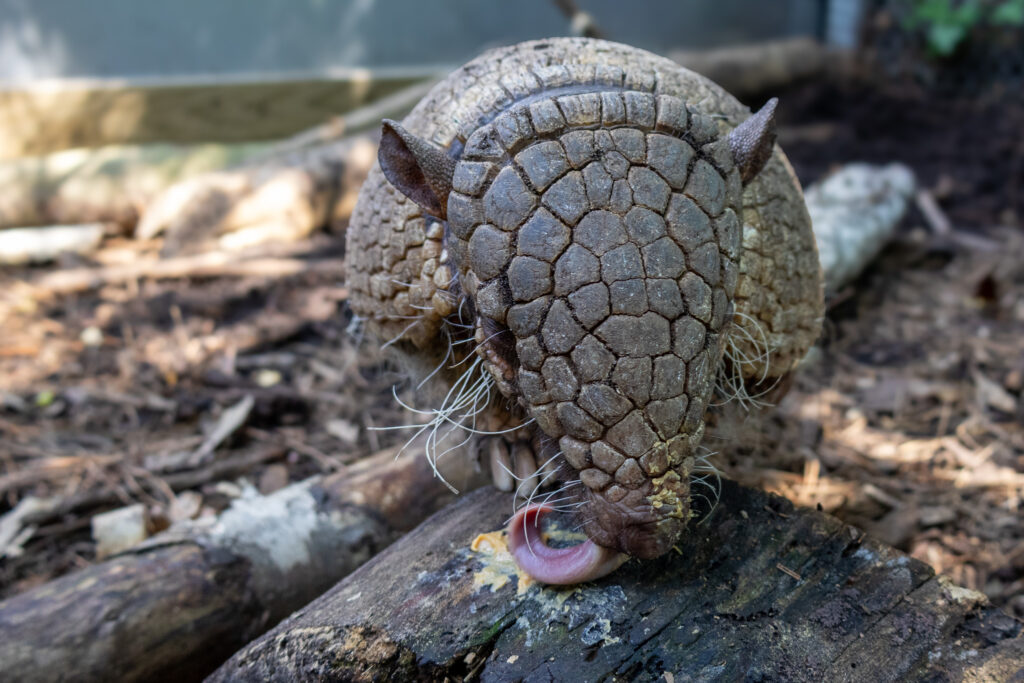
Junebug is the only six-banded armadillo resident at the Virginia Zoo, but that is not the only thing that makes her so special! Six-banded armadillos are reported to have an average lifespan of 18-20 years, but Junebug has far exceeded expectations. Assistant Curator of ZooFarm Martha first met Junebug 19 years ago when she lived in the World of Reptiles with her fellow scaly friends, including her former mate Bobby and their young. Today, Junebug shares a quiet behind-the-scenes space with white-faced saki monkeys as their public-facing habitat in the World of Reptiles Conservatory undergoes renovations.
Even at her advanced age, Junebug is still known to have a feisty personality. She enjoys exploring her keepers’ shoes, digging burrows, and playing with squeaky toys in her den. Junebug’s favorite snacks are peanut butter, honey, mealworms, and waxworms – sweet and savory snacks that match her personality!
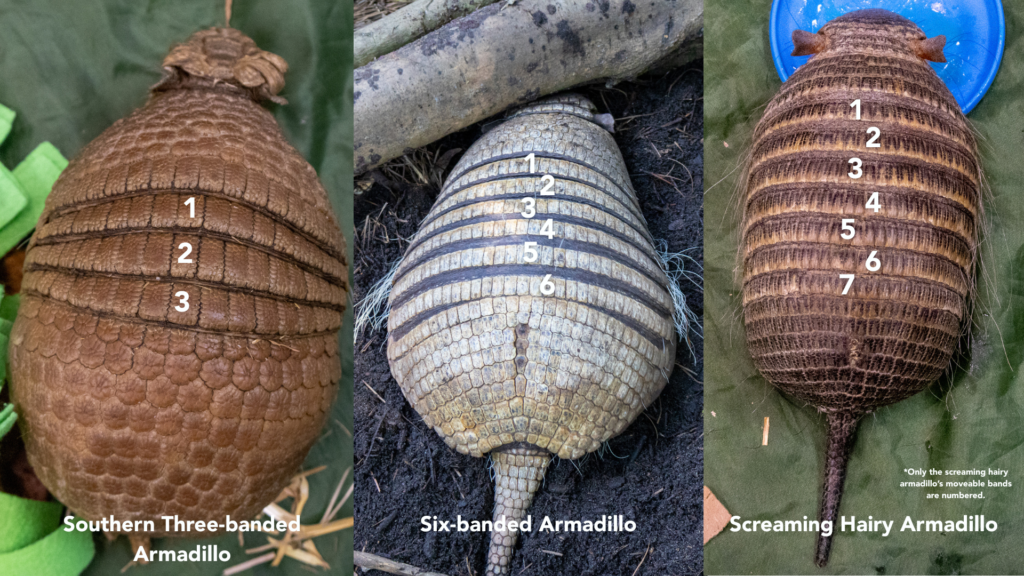
Celebrating International Armadillo Day is an important way to raise awareness for these animals, as the populations of most armadillo species are decreasing according to the International Union for the Conservation of Nature (IUCN). There are also several species that are not researched thoroughly enough (considered data deficient by the IUCN) to determine if their populations are in danger! Due to their burrowing behaviors, armadillos are threatened by extermination in retaliation for digging up gardens or crops. Their habitat is also frequently fragmented by roads, so armadillos can be hit by cars when they are searching for food or a new home. In some parts of their ranges, armadillos are still eaten by local people, or their shells are used to make crafts. One way you can protect armadillos is by visiting Association of Zoos and Aquariums (AZA) accredited facilities, like the Virginia Zoo, that breed healthy armadillo populations in human care to give their species a future for years to come!