 Gift
Gift Tickets
 Membership
 Contact
 Donate
 Shop
ShopAmerican Kestrel
*This page is under renovation and all information may not be up-to-date or complete*
This animal is an Animal Ambassador and lives behind the scenes. Animal Ambassadors attend school programs, special events, ZooLive! Stage Shows, guest engagement activities, and outreach events.
Description
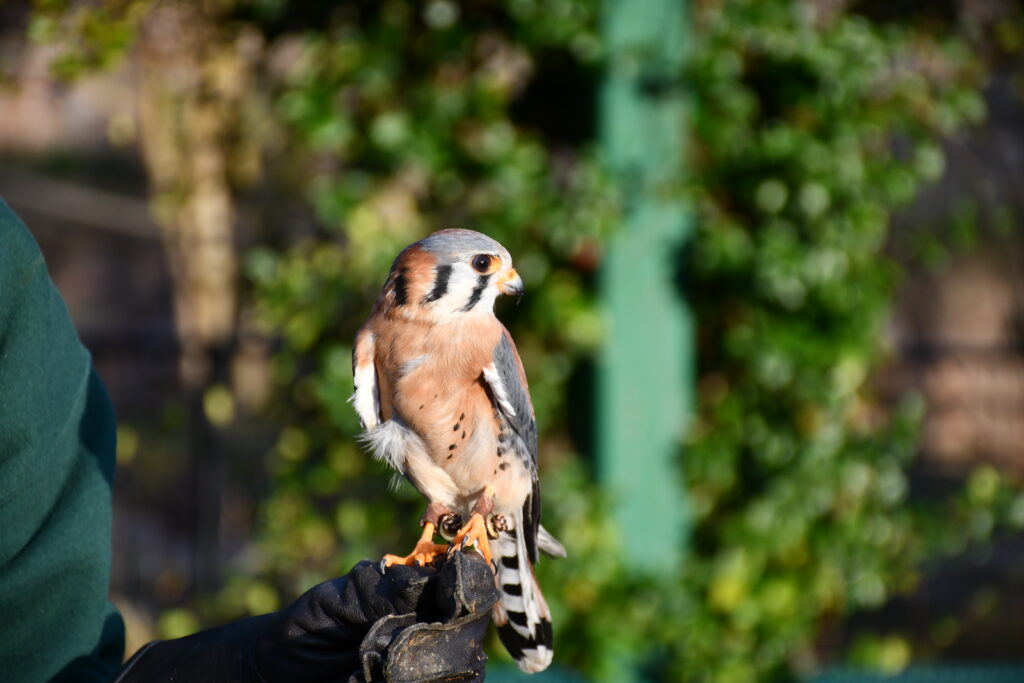
American kestrels are the smallest North American falcons, and one of only three raptors in North America where males and females look different from each other. Adult males have slate blue heads and patches on their wings, rust and black back feathers, and orange-brown feathers on their chest. Adult females are a orange-brown overall with black barring on their wings and back. They also have a crown of gray feathers right above their eyes and are 10-15 percent larger than males. Both sexes have vertical black stripes on their faces below their eyes.
Range & Habitat
American kestrels are the smallest North American falcons, and one of only three raptors in North America where males and females look different from each other. Adult males have slate blue heads and patches on their wings, rust and black back feathers, and orange-brown feathers on their chest. Adult females are a orange-brown overall with black barring on their wings and back. They also have a crown of gray feathers right above their eyes and are 10-15 percent larger than males. Both sexes have vertical black stripes on their faces below their eyes.
At the Virginia Zoo, our American kestrel is an Animal Ambassador and lives behind the scenes.
Behavior
American kestrels are typically monogamous, with some pairs remaining together for several years. If a pair has successfully reproduced in a location before, they will sometimes reuse their old nests in tree or cacti cavities. Females lay nests of about 4 to 6 white to pale brown eggs, usually spotted with brown and grey. Both parents incubate their eggs for 28-31 days. For the first one to two weeks after hatching, the female in a breeding pair stays with young while the male hunts for food. Then, the female and male both hunt. Young kestrels take their first flight at 28-31 days-old. Parent birds continue to feed their young for two to three weeks after fledging (developing flight feathers). Once juveniles are out on their own, they stay close to their siblings.
Diet
American kestrels are carnivores, but their diet is highly varied. They may eat grasshoppers, beetles, dragonflies, moths, mice, voles, small birds, lizards, frogs, earthworms, and more.
Conservation
Fun Facts
- Kestrels can see ultraviolet light, or colors that are invisible to the human eye!
Virginia Zoo Animals
Male: Killian (born: 6/15/2021)
Scientific Name
Falco sparverius
IUCN Conservation Status
Least Concern
Size
Wingspan: 20-24 inches
Length: 8-12 inches
Weight: 3-6 ounces
Life Expectancy
5 years in the wild, up to 15 years in human care