 Gift
Gift Tickets
 Membership
 Contact
 Donate
 Shop
ShopCheetah
*This page is under renovation and all information may not be up-to-date or complete*
Description
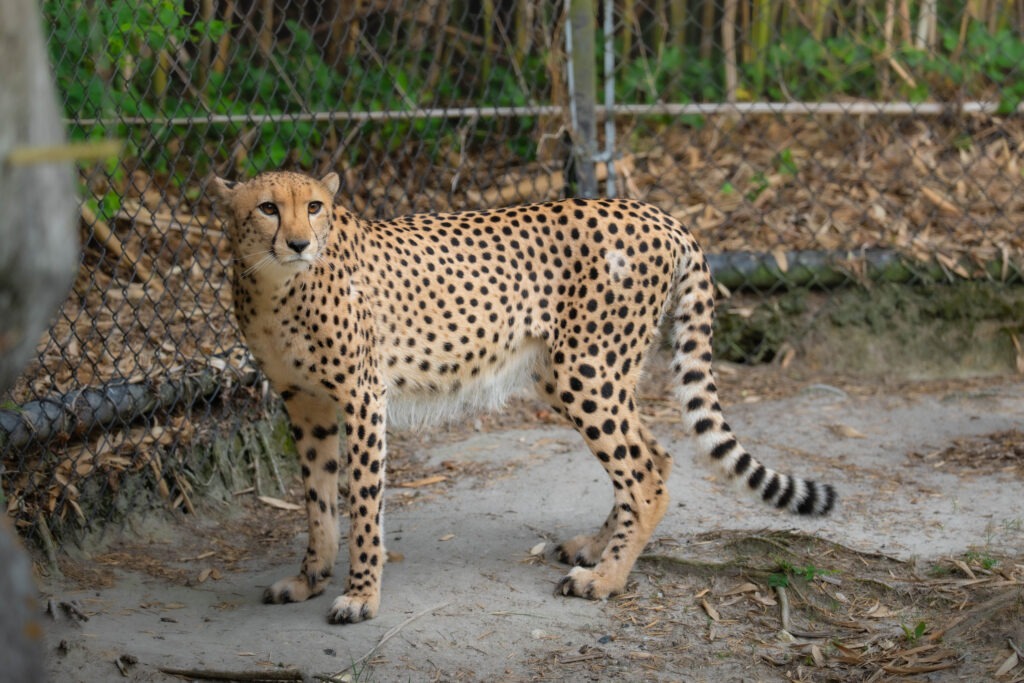
Cheetahs have a slender build and long legs. The fur on their backs is beige or tan with solid black spots. They have black tear marks on their face from the inner corner of each eye down to their mouth. The fur on their neck and stomach is white without spots. Cheetahs also have four to six black rings at the end of their tail.
Cheetah cubs are a smoky gray color. They have a patch of long hair, called a mantle, running along their backs.
Range & Habitat
Cheetahs inhabit a wide range of areas in Africa, including North Africa, the Sahel, eastern, and southern Africa. They may be found in various habitats, including grasslands, savannas, densely vegetated areas, and mountainous areas.
At the Virginia Zoo, our cheetah can be found on the African Safari Trail.
Behavior
Cheetahs have a unique social structure. Adult females are solitary, while adult males or not. Females interact with males to breed, and then they raise their cubs alone. When the cubs reach about 18 months old, the mother leaves them. Siblings stay together for another six months after their mother leaves. Female cubs leave their sibling groups at about two years old, while the males stay together in a group called a coalition.
Coalitions of males live and hunt together as a closely bonded group. Their shared territory may overlap with several female home ranges. When male cheetahs reach sexual maturity, they travel up to 300 miles from where they were raised and claim a territory that typically five to 10 square miles in size.
Young females typically occupy the same area as their mother, and since they are solitary, their home ranges can be significantly larger at about 322-370 square miles in size. During the dry season, several females may overlap in the same area due to scarce resources, but they do not show aggressive behaviors towards each other.
Diet
Cheetahs are carnivores and eat a variety of other animals, including antelopes like springboks, duikers, impala, and gazelles, or game birds and rabbits. They may also eat the young of larger animals, like warthogs, oryx, and kudu.
Conservation
Cheetahs are listed as vulnerable, with decreasing populations, by the International Union for the Conservation of Nature (IUCN). Population studies in 2017 estimated that 6,500 mature individuals, or 7,100 adult and adolescent cheetahs remain in the wild. This species is threatened by habitat loss or fragmentation, lack of available prey, conflict with humans (i.e. ranchers with livestock), illegal trade, and lack of genetic diversity.
Fun Facts
- Cheetahs cannot roar! Lions, tigers, jaguars, and leopards (the big cats) all have a ligament in the place of an epihyal bone. When stretched, this ligament creates a larger sound-producing passage and allows them to have a wider range of pitch. Cheetahs have a fixed vocal cord structure that allows them to purr, chirp, or yelp, but they cannot roar.
- Cheetahs can accelerate from zero to 45 miles per hour in just 2.5 seconds and reach top speeds of 60-70 miles per hour. This makes them the fastest land mammal!
- Cheetahs have very low levels of genetic variation compared to other mammals due to a severe population reduction, or bottleneck, that occurred 10,000 years ago. This means cheetahs are highly susceptible to disease and they are not as adaptable to changing environmental conditions.
Virginia Zoo Animals
Males: Cashew and Walnut (born: June 20, 2023)
Scientific Name
Acinonyx jubatus
IUCN Conservation Status
Vulnerable
Size
Weight: 77-143 lbs.
Length: 3.5-4.5 feet
Life Expectancy
8-10 years in the wild, 12-15 years in human care