 Gift
Gift Tickets
 Membership
 Contact
 Donate
 Shop
ShopPrevost’s Squirrel
*This page is under renovation and all information may not be up-to-date or complete*
Description
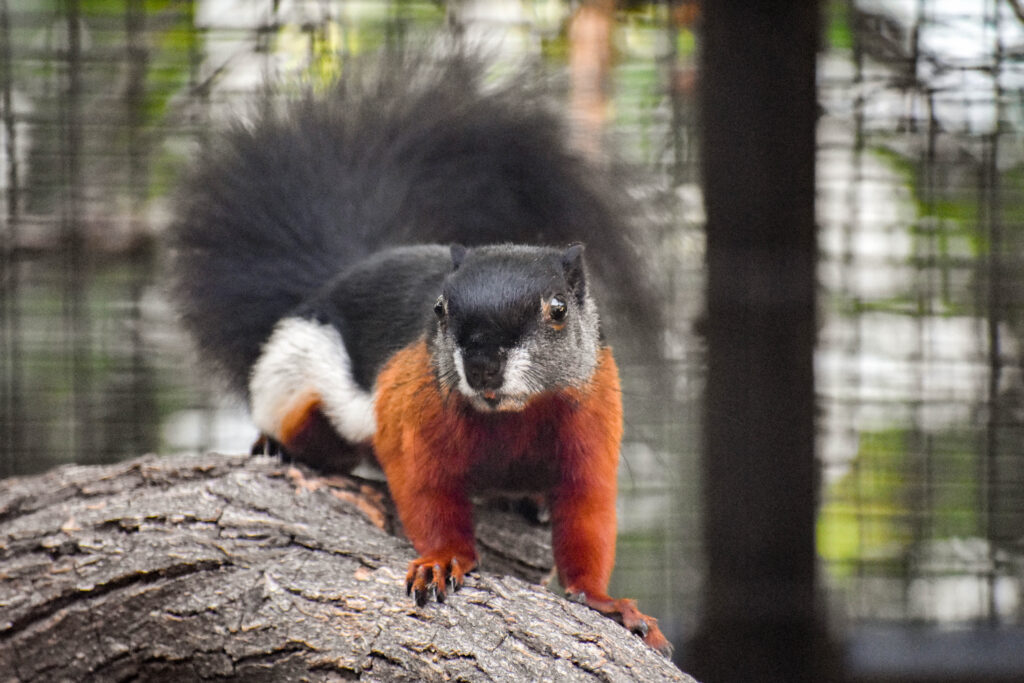
Prevost’s squirrels are three colors. The top of their heads, their back, and their tail are black, their belly is a reddish-brown or chestnut color, and they have a white line separating the two colors.
Range & Habitat
Prevost’s squirrels are native to Southeast Asia in the trees of the Malaysian Peninsula, Sumatra, Borneo, and the East Indies.
At the Virginia Zoo, you can find me in the yellow barn in the ZooFarm.
Behavior
Prevost’s squirrels are considered crepuscular, meaning they are most active at dawn and dusk. At night, this species rests in hollowed out trees or on branches in nests made of leaves and twigs.
When feeding, Prevost’s squirrels sit on their hind legs and hold their food between their front paws.
Prevost’s squirrels breed throughout the year, but they are most frequently mating between June and August. Females are able to birth up to three litters each year, with one or two young per litter on average. Prevost’s squirrel babies are born with their eyes closed and without teeth or fur. However, by six weeks old, they are able to venture out of their burrows.
Diet
Prevost’s squirrels eat fruit, nuts, seeds, buds, flowers, insects, and bird eggs.
Conservation
The biggest threat to Prevost’s squirrels is habitat loss, as much of the remaining habitat of this species has been replaced by plantations. In some parts of their habitat, they are being heavily collected for the pet trade.
Fun Facts
- Unlike ground squirrels, tree squirrels do not hibernate.
- Prevost’s squirrels wrap their tails around their bodies for warmth when sleeping.
Virginia Zoo Animals
Male: Kelapa (03/29/2019)
Scientific Name
Callosciurus prevostii
IUCN Conservation Status
Least Concern
Size
Length: 5-11 inches.
Weight: 11 ounces.
Life Expectancy
Up to 15 years in human care