 Gift
Gift Tickets
 Membership
 Contact
 Donate
 Shop
ShopFire-bellied Toad
*This page is under renovation and all information may not be up-to-date or complete*
Description
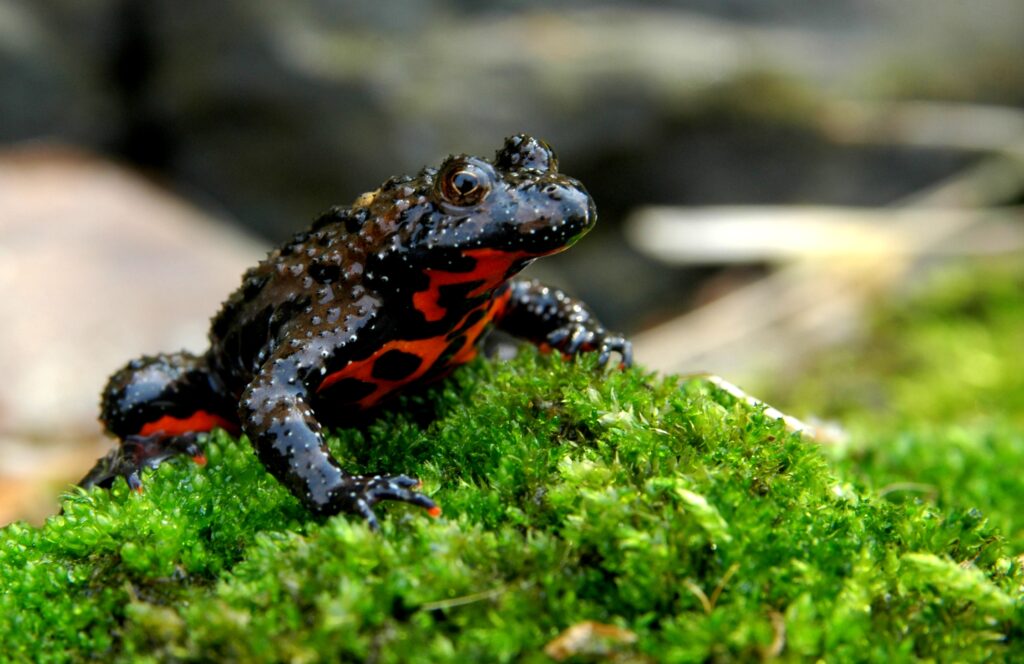
Fire-bellied toads have brown or green and black backs covered in rough warts, or tubercules. Their belly underside is smooth and marbled red or red-orange with dark spots. Unlike other toads, this species has triangular shaped pupils.
Range & Habitat
Fire-bellied toads are native to northeastern China, North and South Korea, and some parts of Russia. There is a small introduced population of fire-bellied toads in Beijing, China.
These toads are aquatic, so they spend most of their time in slow-moving streams and ponds. Terrestrial habitats include mixed, coniferous, and broad-leaf forests, open meadows, river valleys, and swamp lands.
At the Virginia Zoo, our fire-bellied toad is an animal ambassador and lives behind the scenes.
Behavior
Fire-bellied toads are gregarious, meaning they can be found in groups. From fall to late spring, this species hibernates in small groups of one to six individuals. During this time, they hide in rotten trees, piles of stones or leaves, or underwater in streams. In mid-May, when temperatures are higher, the toads emerge and breed.
When fire-bellied toads feel threatened, they go into a defensive posture called the “Unken reflex”. In this posture, toads bend their back downward to form a concave surface that shows the edges of their bright belly. They also hold up their limbs and arch their head backwards. If these toads are actually attacked, they will lay on their back to show their entire red belly. If the attack continues, the toad secretes a milky toxin their pores that irritates the eyes and mouth of the predator.
Male fire-bellied toads do not have a vocal sac resonator, unlike most other frogs and toads. This .
Diet
Fire-bellied toads are carnivores and feed on invertebrates, including worms, snails, or insects.
Conservation
Though this species is considered to be of Least Concern according to the International Union for the Conservation of Nature (IUCN), they are threatened by habitat loss due to residential and commercial development, pollution, and the pet trade.
Fun Facts
- Male fire-bellied toads do not have a vocal sac resonator, unlike most other frogs and toads. This means that they produce vocalizations by inhaling, rather than exhaling.
- Fire-bellied toads do not have a tympanic membrane, or eardrum, unlike most other species of frogs and toads!
- Toads in the Bombina genus cannot extend their tongues to feed – they leap forward to catch prey with their mouth.
Virginia Zoo Animals
Female: Thalia
Scientific Name
Bombina orientalis
IUCN Conservation Status
Least Concern
Size
Length: 2 inches
Life Expectancy
12-15 years in the wild, but may reach 20 years-old in human care