 Gift
Gift Tickets
 Membership
 Contact
 Donate
 Shop
ShopStanley Crane
*This page is under renovation and all information may not be up-to-date or complete*
Description
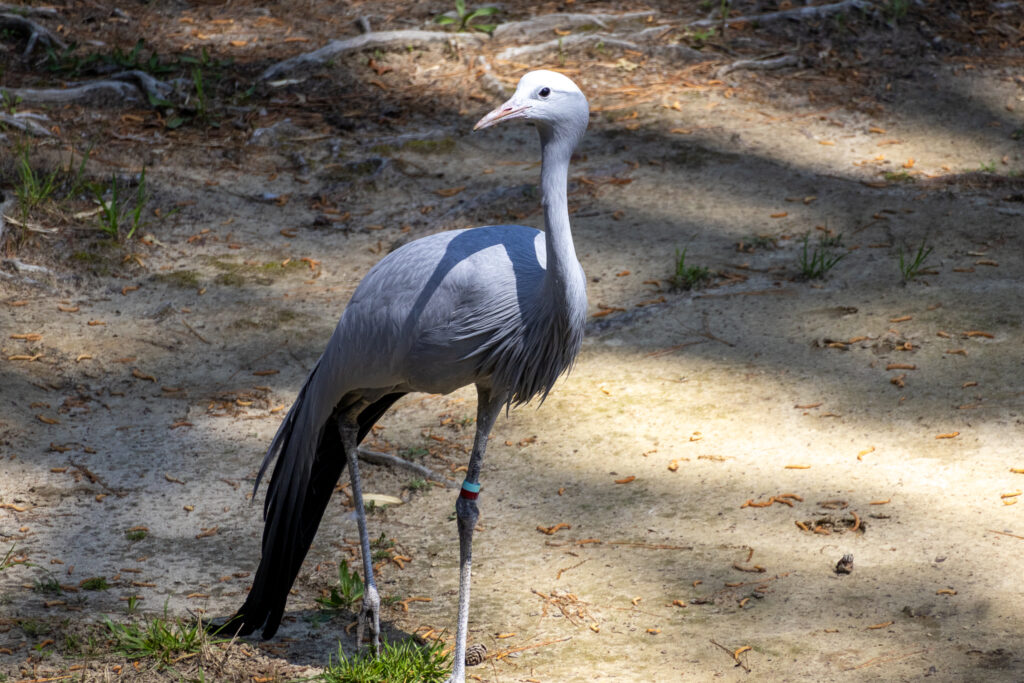
Stanley cranes are tall birds with pale blue-gray feathers covering their head and body. Their wing feathers are quite long, appearing to be tail feathers, but their tail feathers are actually very short. They are only one of two species of crane that do not have red skin on their heads.
Range & Habitat
Stanley cranes have the smallest range of any crane species. An estimated 99% of this species’ population lives in South Africa.
At the Virginia Zoo, Stanley cranes can be found in a mixed-species habitat with our eastern mountain bongo on the African Safari Trail.
Behavior
Stanley cranes live in breeding pairs with one or two chicks. However, during migration, they gather in larger flocks.
This species prefers to nest in high elevation grasslands, where there are fewer disturbances. However, during the winter, they move to lower altitudes.
Diet
Stanley cranes are omnivores. Most of their diet consists of seeds and insects.
Conservation
Since the 1970s, this species has been declining due to poisoning on agricultural lands. Farmers can unintentionally poison Stanley cranes with bait or chemicals on crops intended to prevent rodents and geese from damaging them. Conversions of grasslands to forest through afforestation projects also reduce available nesting habitat.
Fun Facts
- Other names for the Stanley crane include the blue crane or the paradise crane.
- The Stanley crane is the national bird of South Africa.
- Indigenous groups in Africa showed great respect for the Stanley crane. In fact, amongst the Zulu people, royalty were the only people allowed to wear Stanley crane feathers. In Xhosa groups, only warriors wore Stanley crane feathers, and they were worn into battle.
Virginia Zoo Animals
Females: Gertrude (hatched: 5/29/2010) & Beatrice (hatched: 07/14/2010)
Scientific Name
Anthropoides paradiseus
IUCN Conservation Status
Vulnerable
Size
Males: 330-530 lbs.
Females: 270-400 lbs.
Life Expectancy
20-30 years in the wild, up to 50 years in human care