 Gift
Gift Tickets
 Membership
 Contact
 Donate
 Shop
ShopSouthern Ground Hornbill
*This page is under renovation and all information may not be up-to-date or complete*
Description
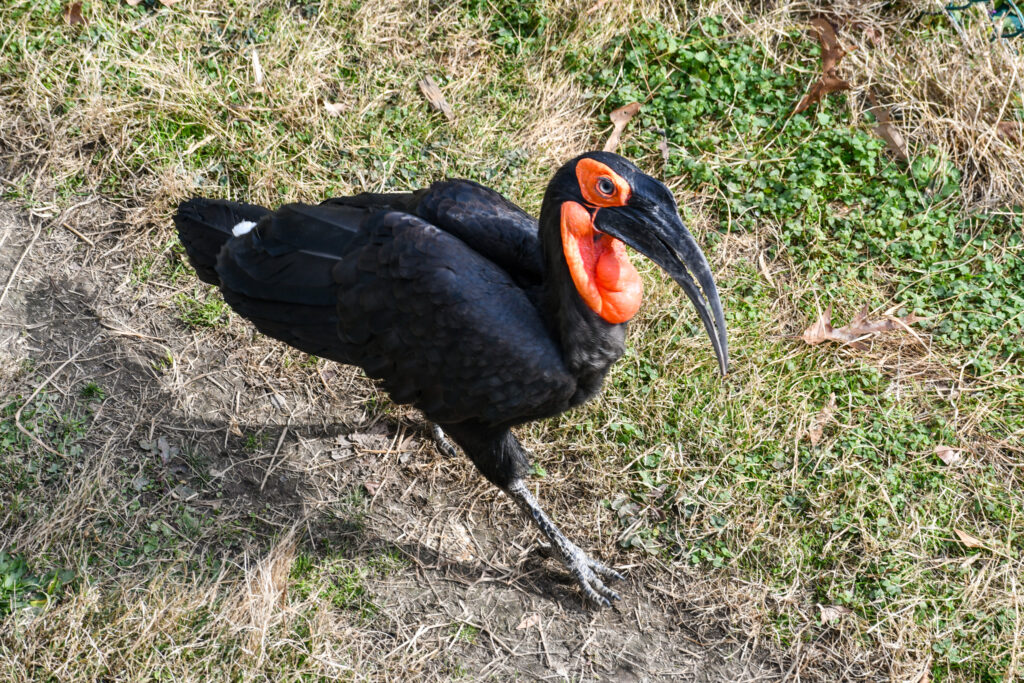
Southern ground hornbills are large birds covered in black plumage. They have large, down-curved bills used to pluck small animals from the grasses and shrubs in their native habitats. Males and females exhibit sexual dimorphism, meaning they have distinct differences in appearance. Males are larger and have red throats, while females are smaller and have blue throat patches.
Range & Habitat
Southern ground hornbills are found in dry grasslands and shrublands in Africa. They are found from Central Africa, including Kenya, Tanzania, and the Democratic Republic of the Congo, to Botswana and South Africa.
At the Virginia Zoo, southern ground hornbills can be found in a mixed-species habitat with Masai giraffes on the African Safari Trail.
Behavior
As their name suggests, southern ground hornbills spend most of their time on the ground. They are non-migratory, maintaining a large territory defended with loud vocalizations.
Southern ground hornbills may live as single breeding pairs, but more commonly they live in a cooperative breeding group. Within the breeding group, the largest birds in the flock are considered to be the dominant pair. The rest of the group helps care for young. Breeding groups consist of 2 to 11 individuals.
Diet
Southern ground hornbills are carnivores. They eat invertebrates like arthropods, amphibians, lizards, snakes (including venomous snakes!), and small mammals.
Conservation
Southern ground hornbill populations are decreasing in the wild. Major threats to this species include loss of nesting habitat, whether this is from small-scale agriculture or extreme weather events. This species can become heat stressed, so increasing temperatures related to climate change could post a threat.
Fun Facts
- The dominant breeding pair in a flock of these birds typically only lays eggs once every 6 years.
- Southern ground hornbills are the largest hornbill species.
Virginia Zoo Animals
Male: Shetani (born: 4/22/2002)
Scientific Name
Bucorvus leadbeateri
IUCN Conservation Status
Vulnerable
Size
Wingspan: 4-6 feet
Males: 7-14 lbs
Females: 5-10 lbs
Life Expectancy
30 – 40 years in the wild, up to 60 years in human care