 Gift
Gift Tickets
 Membership
 Contact
 Donate
 Shop
ShopGreen Anaconda
*This page is under renovation and all information may not be up-to-date or complete*
Description
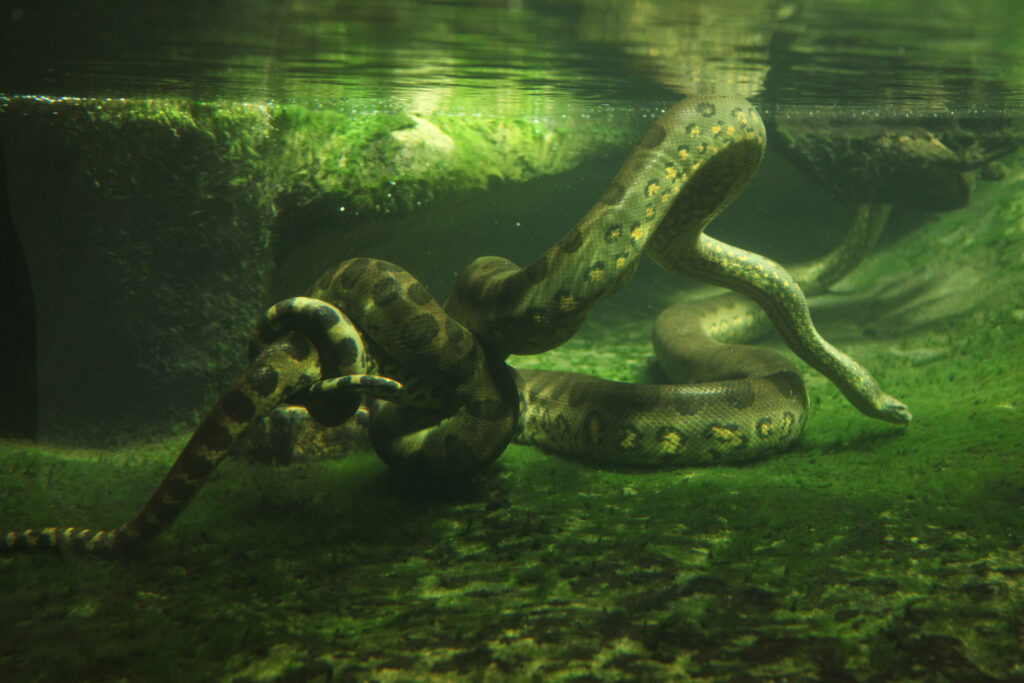
Green anacondas are large, olive green snakes with dark oval spots along their spines and yellow-centered spots along their sides. The scales on their belly side are yellow and black.
Anacondas prefer to be in or near water and are excellent swimmers. Their eyes and nostrils are on top of their head, allowing them to keep their body hidden underwater while they wait for prey to approach.
Range & Habitat
Green anacondas are native to northern South America. They are abundant in the Orinoco Basin in Colombia, the Amazon River Basin in Brazil, and flooded grasslands in Venezuela. They are also found in less concentrated numbers in Ecuador, Peru, Bolivia, Guyana, Paraguay, French Guiana, and Trinidad.
At the Virginia Zoo, our green anaconda can be found in the World of Reptiles.
Behavior
Green anacondas are typically solitary except during breeding season. Green anacondas mate during the dry season which generally occurs from March through May. Male anacondas form groups of up to 13 snakes surrounding a singular female to mate with her. Mating occurs for up to a month. After mating, the female may consume one or more of the smaller males in the group. Females do not eat during the entire 7 month gestation period. Since breeding is such an energy intensive process, green anacondas only mate every other year. Females give live birth in the water to 20-40 young.
Diet
Like all species of snake, green anacondas are carnivores. Juveniles tend to eat fish, birds, and small mammals. Adults are able to consume larger animals, such as deer, capybara, caimans, and large birds.
Conservation
Green anacondas are considered to be of Least Concern by the International Union for the Conservation of Nature (IUCN), but they were last assessed in 2014. More research is needed to determine population trends of this species. The biggest threats to this species include habitat loss through deforestation and hunting by humans.
Fun Facts
- A group of anacondas is called a bed or knot.
Virginia Zoo Animals
Female: Angie
Scientific Name
Eunectes murinus
IUCN Conservation Status
Least Concern
Size
Length: 30 feet
Weight: 550 lbs.
Life Expectancy
10 years in the wild, but upwards of 20 years in human care