 Gift
Gift Tickets
 Membership
 Contact
 Donate
 Shop
ShopDiamondback Terrapin
*This page is under renovation and all information may not be up-to-date or complete*
This animal is an Animal Ambassador and lives behind-the-scenes. Animal Ambassadors attend school programs, special events, ZooLive! Stage Shows, guest engagement activities, and outreach events.
Description
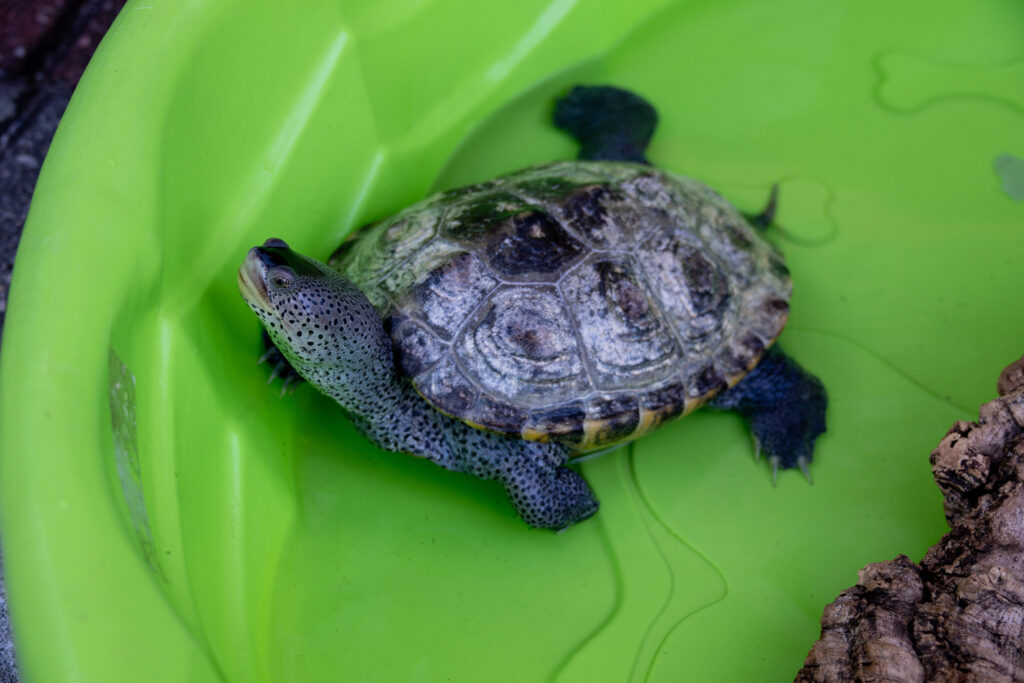
Diamondback terrapins have concentric, diamond-shaped markings and grooves on the scutes (plates) of their top shells. This top shell, also known as their carapace, may be grayish brown or black. This terrapin’s skin is a pale gray color with black splotches or stripes.
This species can live in environments with daily tidal changes and strong currents, so they have large webbed feet and muscular legs that allow them to be excellent swimmers.
Range & Habitat
These turtles are found in coastal salt marshes, estuaries, and tidal creeks along the Atlantic and Gulf coasts of the United States as far north as Cape Cod, Massachusetts, south as the Florida Keys, and west to Corpus Christi, Texas. There are seven subspecies of diamondback terrapin that occupy this range.
Our diamondback terrapin is an animal ambassador and lives behind the scenes.
Behavior
Diamondback terrapins mate at night during May. After mating, females dig shallow nests on beaches and lay 10-15 pinkish-white eggs. Females may lay more than one clutch during the season. Eggs hatch 60 to 100 days after being laid, but if the hatchlings do not emerge by the onset of cold weather, they can overwinter in the sand and hatch the next spring.
During the cold winter months, diamondback terrapins brumate. This semi-dormant state is similar to hibernation and allows turtles to survive when food is scarce by slowing down their metabolism. Diamondback terrapins bury themselves in the mud at the bottom of tidal creeks during this period of inactivity.
Diet
Diamondback terrapins are almost strictly carnivorous. They have strong jaws and crushing plates in their mouths that allow them to eat hard-shelled prey, including aquatic snails, crabs, mussels, and clams. They may also eat carrion, fish, worms, or insects. Occasionally, diamondback terrapins may ingest small amounts of plant matter, but this is not their preferred food source.
Conservation
Historically from the late 1880s to the early 1900s, diamondback turtle populations were threatened by commercial harvest, as this species was a popular ingredient in turtle soup. The commercial demand for these turtles ended by the 1930s, partially due to low turtle populations, but also because of Prohibition. Sherry wine was another key ingredient in the soup and was largely inaccessible.
Today, diamondback terrapins face many threats including habitat loss, boat strikes, and nest predation. However, the greatest threat to these turtles is drowning in crab pots. Diamondback terrapins enjoy the same bait that is used to lure blue crabs into traps, and once inside the trap, they have difficulty escaping to breathe at the surface. Recreational crabbers often set pots in shallow waters along creeks and marshes, which is an important habitat for smaller males and juvenile females. Crabbers can help conserve diamondback terrapins by installing bycatch reduction devices on their equipment to prevent terrapins and other non-target animals from entering their pots!
Fun Facts
- Diamondback terrapins are the only turtles in the United States that are exclusively found in brackish water, which is an intermediate between freshwater and saltwater.
- Like sea turtles, diamondback terrapins have glands to remove excess salt from their bodies by secreting extra salty tears.
- Diamondback terrapins are the official state reptile of Maryland!
- You can determine an individual terrapin’s age by counting the number of growth rings on their scutes.
Virginia Zoo Animals
Female: Lori
Scientific Name
Malaclemys terrapin
IUCN Conservation Status
Vulnerable
Size
Males: Maximum shell length of 5.5 inches
Females: Maximum shell length 11 inches
Life Expectancy
Up to 40 years in human care