 Gift
Gift Tickets
 Membership
 Contact
 Donate
 Shop
ShopBornean Orangutan
Description
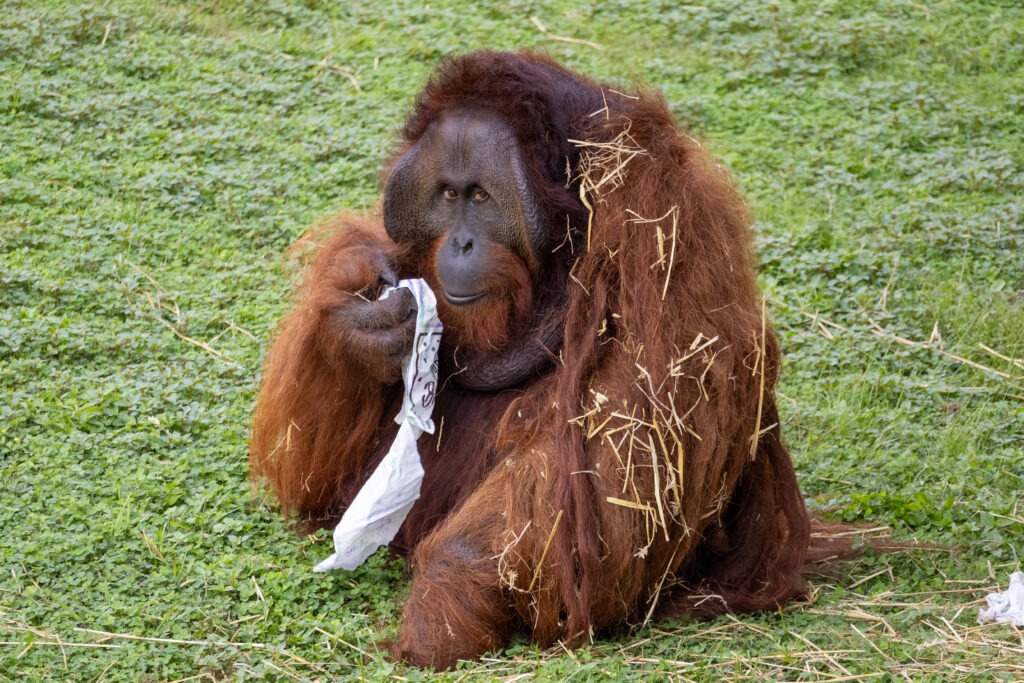
Bornean orangutans are large primates covered in reddish-orange hair. Males grow to be more than twice the size of females and grow longer hair and large cheek pads called flanges. Both males and females have throat sacs which amplify their vocalizations through the forest.
Bornean orangutans are distinct from Sumatran orangutans in that they have broader faces, shorter beards, and slightly darker hair colors.
Range & Habitat
There are three distinct species of orangutans. Bornean orangutans are only found on the island of Borneo (both the Malaysian and Indonesian sides of the island). Sumatran and Tapanuli orangutans are both found on the island of Sumatra. Orangutans live in the remaining isolated fragments of tropical rainforests and secondary hill forests down to swampy areas and will occasionally visit grasslands, cultivated fields and shallow lakes.
At the Virginia Zoo, orangutans can be found on Asia: Trail of the Tiger.
Behavior
Orangutans are the largest arboreal, tree-dwelling, mammals on Earth. Every night, orangutans build nests from branches and foliage where they sleep.
Orangutans are often described as semi-solitary or solitary but social unlike other great apes which live in larger family groups. Flanged adult males are typically the most solitary of all age/sex classes; their socialization is usually limited to temporary relationships with females for breeding purposes. In the wild, males do not provide parental care to offspring. Adult females provide extensive parental care to their young and interact with males when they are receptive to breeding. Subadult males may interact with subadult females, and subadult females may travel together in small groups of individuals that are about the same age. This unique social structure is thought to be a function of their dependence on ripe fruit. Ripe fruit is scattered throughout the forest and is not consistently available. If orangutans lived and traveled in large, permanent groups, then they would quickly exhaust available resources.
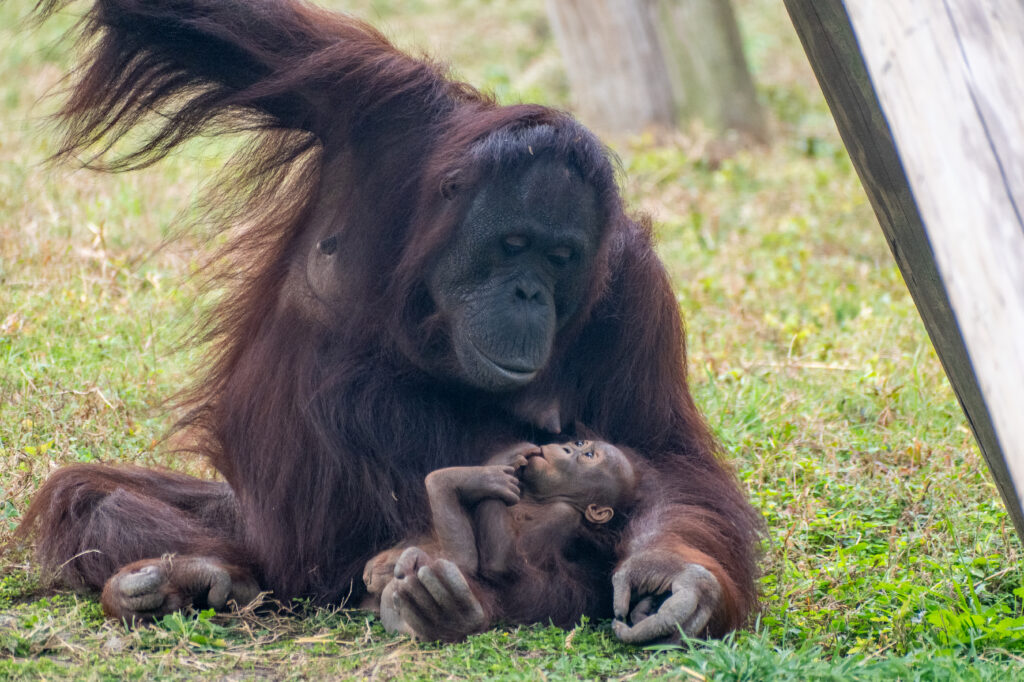
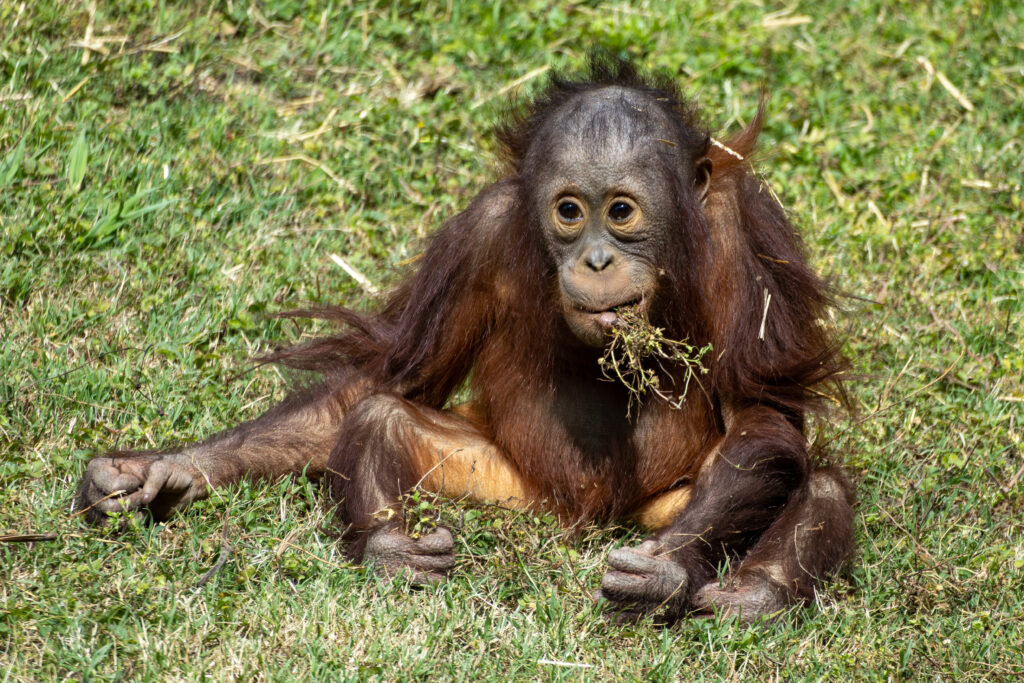
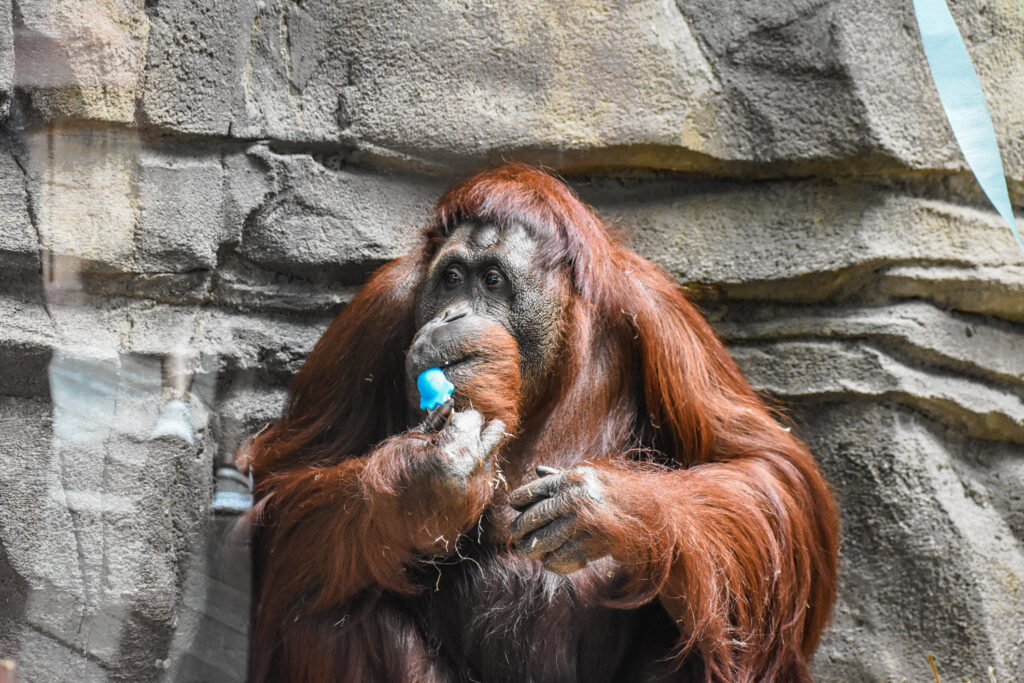
Without the pressures of foraging, our Zoo is able to house family groups of orangutans with strong social connections. At the Virginia Zoo, we have two separate family groups of orangutans. Pepper and Schnitz are an older companion pair, meaning they will not have any offspring. Dara and Solaris are a Species Survival Plan (SSP) recommended breeding pair, and Poppy is their offspring.
Females will reach maturity at 11-15 years old while males reach maturity at 8-10 years old. Males who develop flanges can develop these structures from age 14-30. Not all sexually mature males develop flanges. Females will carry their offspring until they are up to 5 years old, and they may continue to breastfeed their offspring until they are 8 years old.
Diet
Orangutans are considered frugivores because over 60% of their diet consists of ripe fruit. However, they also eat leaves, bark, vines, sap, roots, insects, and sometimes even small mammals.
Conservation
Bornean orangutans are critically endangered due to habitat loss and poaching. One threat to orangutan habitat is palm oil. Palm oil is found in a wide variety of items including processed foods, personal care products, and cleaning products. You can take action by making responsible consumer choices and only purchasing products made from sustainably-produced palm oil or products that do not contain palm oil. Download the World Association of Zoos and Aquariums’ (WAZA) free PalmOil Scan app to learn more about the ingredients in your frequently purchased items.
Fun Facts
- The Malay name for orangutans, “Orang Hutan” translates to “person of the forest.”
- Orangutans share approximately 97% of their DNA with humans.
- They are the only great ape species native to Asia.
Virginia Zoo Animals
Family Group 1: Schnitz (male – born: 6/27/1982) & Pepper (female – born: 5/22/1980)
Family Group 2: Solaris (male – born: 6/22/2003), Dara (female – born: 9/23/1999) and Poppy (female – born: 6/29/2024)
Scientific Name
Pongo pygmaeus
Threat Level
Critically Endangered
Size
Males: 3.2 ft. tall, 110-220 lbs.
Females: 2.5 ft. tall, 66-110 lbs.
Life Expectancy
35-45 years in the wild but into their 60s in human care
Poppy
Solaris
Pepper