Gift
Gift Tickets
 Membership
 Contact
 Donate
 Shop
ShopSouthern Cassowary
Description
Southern cassowaries are tall, flightless birds that are among the largest birds on the planet. The southern cassowary reaches 5.8 feet in height and over 100 pounds!
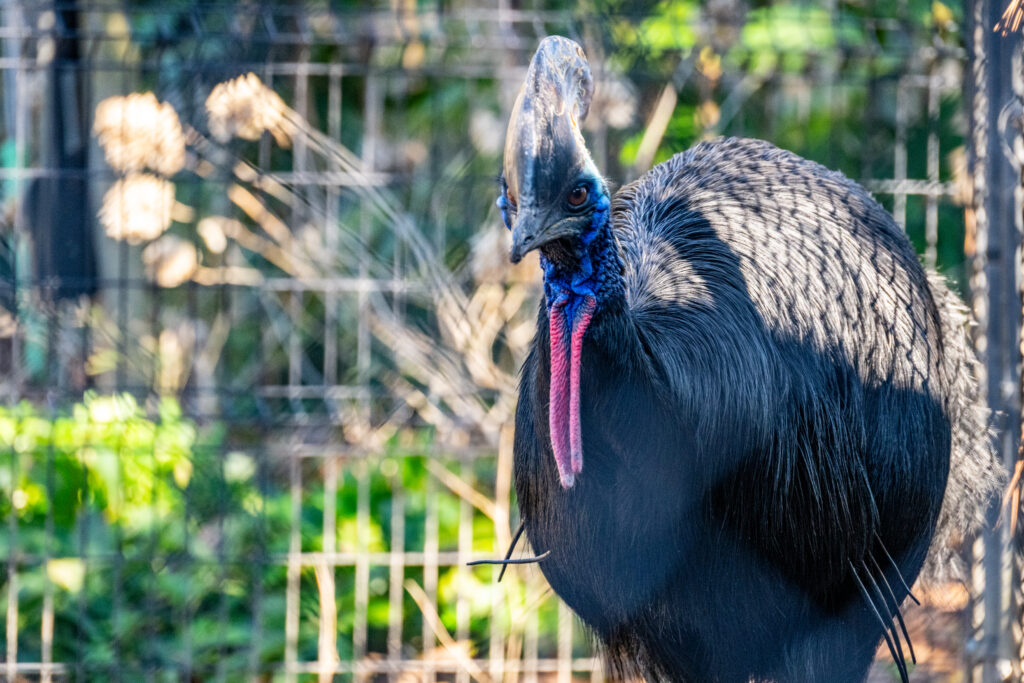
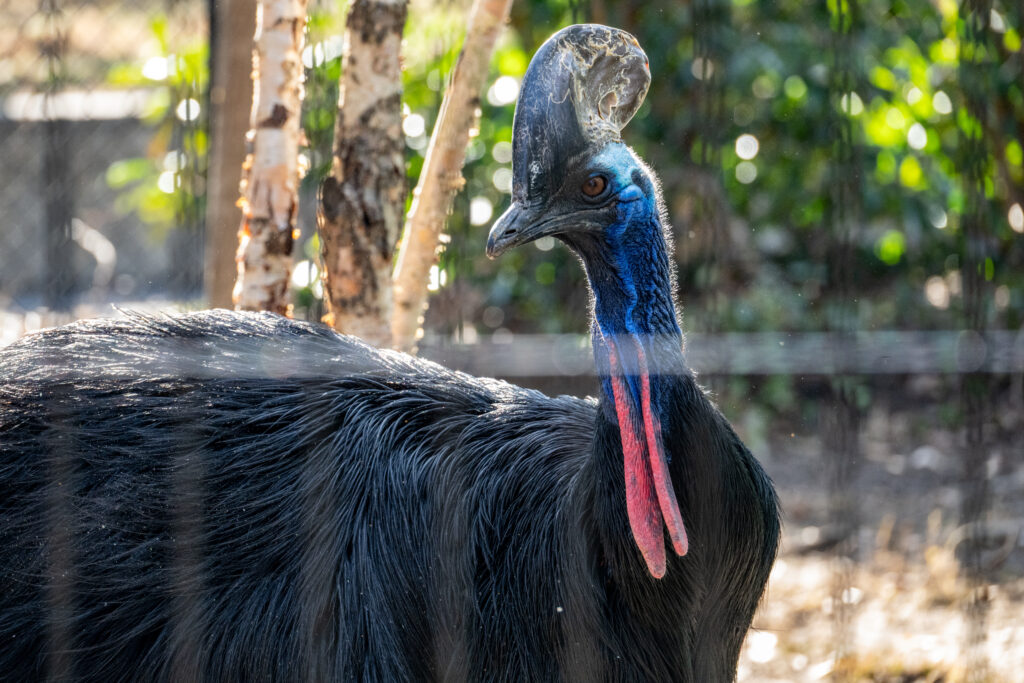
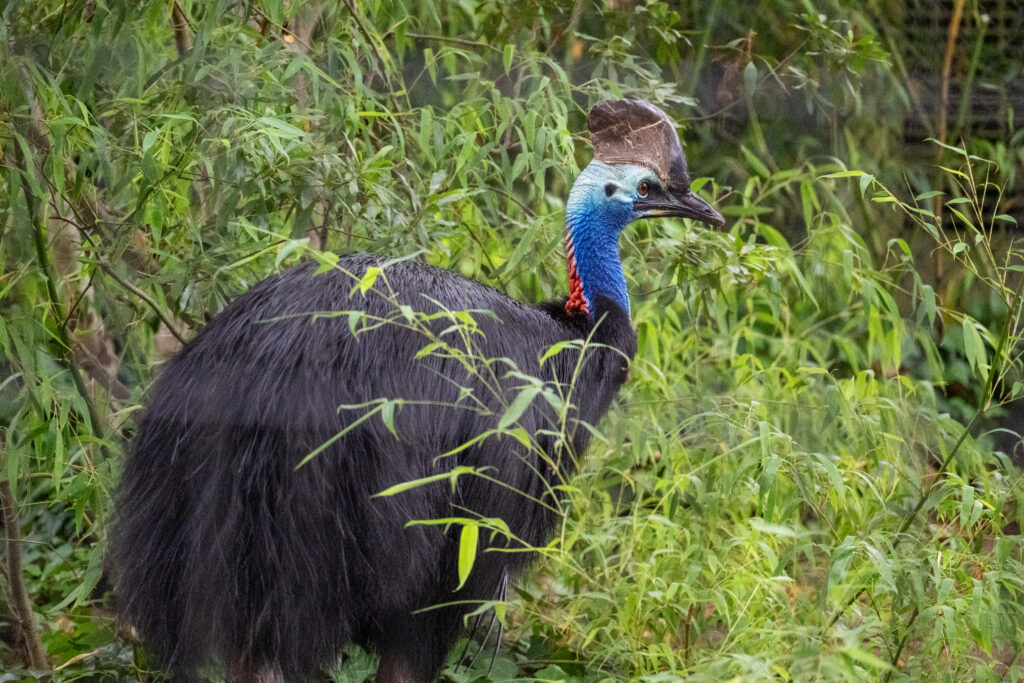
These birds have black, satin-like feathers on the lower part of their neck, their body, and their tail. Additionally, they have hardened quills that look like long spines at the edges of their wings instead of flight feathers.
The skin on the cassowary’s neck and face is blue and bright red. On the front of their necks, southern cassowaries have two bright red wattles (dangling skin which can inflate). Consequently, another common name for this species is the double-wattled or two-wattled cassowary.
Cassowaries also have a large, helmet-like keratin structure on the top of their head called a casque. Though scientists once thought this structure served to amplify the cassowary’s booming calls, newer research shows that it likely plays a key role in regulating their body temperature!
Range & Habitat
Southern cassowaries are native to dense tropical rainforest habitats in Australia, Indonesia, and Papua New Guinea.
Behavior
Southern cassowaries are diurnal, or mostly active during the day.
Southern cassowaries are solitary. It is thought that their low-frequency sounds, some of the lowest-frequency sounds of any bird, are used to communicate with others over long distances. This could help them avoid other individuals or locate mating opportunities.
When threatened, southern cassowaries may use a stretch display (raised feathers, extended wings, and vertically stretched neck/body) to appear even larger. They may also inflate their red wattles.
Diet
Southern cassowaries primarily consume fallen fruit, but they may also eat snails and fungi. In fact, one study from Queensland, Australia, found that southern cassowaries eat the fruits of at least 75 different types of forest plants! Occasionally, southern cassowaries feed on small mammals and reptiles or the carrion of these animals.
Conservation
In Australia, southern cassowaries face a variety of threats including habitat loss and fragmentation, collisions with vehicles, attacks by feral pigs and dogs, as well as introduced diseases. In Indonesia and Papua New Guinea, threats to the southern cassowary include hunting for subsistence, trade, and bride price gifts.
Fun Facts
- Southern cassowaries lay green eggs!
- Southern cassowaries can sprint up to 30 miles per hour for short periods.
- The Virginia Zoo’s southern cassowaries inspired Elation Brewing‘s latest Zoo exclusive beer which will debut at Fall Fest on September 26!
Virginia Zoo Animals
Males: Boris and Hallager (hatched: June 11, 2013)
Females: Portabella (hatched: August 25, 2013) and Elgie (hatched: May 1, 2013)
Scientific Name
Casuarius casuarius
IUCN Conservation Status
Least Concern
Size
Males: 121 lbs.
Females: 167 lbs.
Life Expectancy
Up to 40 years in human care